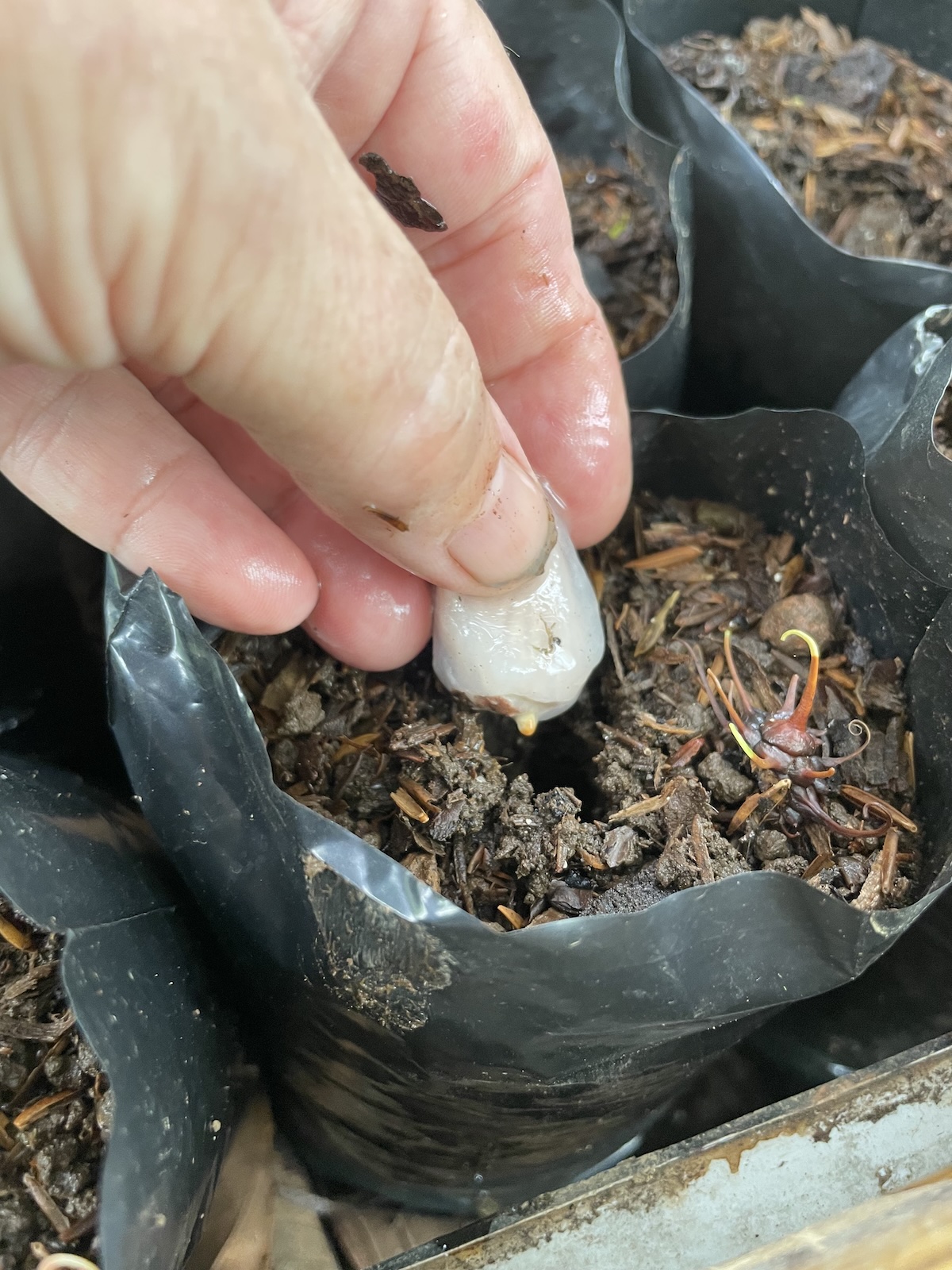
Fresh cacao seed being planted into a nursery bag beside a newly germinated cacao seed on our farm in Sortová, Panama.

What We Plant Now Matters Later

From cacao seed to dark chocolate, the choices made along the way become part of what we eventually eat.

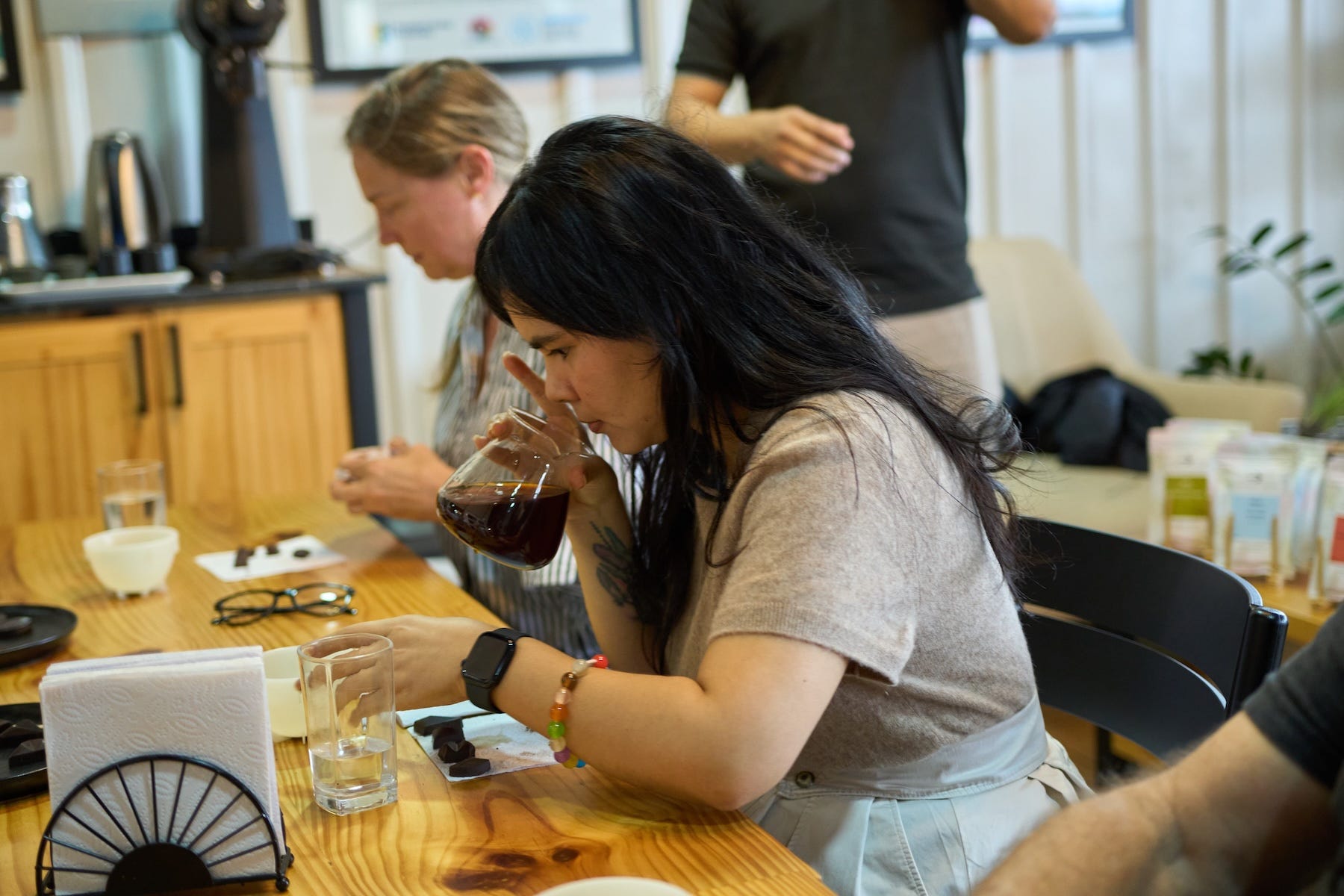
Earlier this week, I stood in front of a room in Boquete talking about dark chocolate and heart health.

Back on the farm, we had also begun working with about 300 new cacao seeds.

They are part of an experiment with our cacao mentor to improve the way we germinate and establish young trees. This time, we are beginning some of the fresh seeds in water so we can watch for the first signs of germination before they move into the nursery.

Cacao seeds need this kind of attention. Unlike the dry seeds we keep in packets for the garden, fresh cacao seed still holds a great deal of moisture and begins losing its ability to germinate if it is allowed to dry. In nature, it is ready to begin growing quite soon after the fruit matures.

If these seedlings establish well, some may eventually become trees we harvest for many years. The choices we make now will shape the cacao we harvest and the chocolate we make years from now.

By the time cacao reaches the chocolate kitchen, years of growing and a series of decisions after harvest have already shaped it.

What cacao percentage can tell us

This was part of what I wanted to explain when we began talking about flavanols and heart health.

Flavanols, sometimes called flavan-3-ols in the research, are natural compounds found in cacao and other plants. Scientists have been particularly interested in their relationship with the endothelium, the thin lining inside our blood vessels.

Healthy endothelial function helps our blood vessels respond and widen when the body needs more blood flow.

Studies of cocoa flavanols have found improvements in endothelial function, including in healthy adults. Researchers also use a test called flow-mediated dilation to see how well an artery widens when blood flow increases, and randomized trials have found improvement there too.

For those of us who enjoy dark chocolate, there is an important detail inside that research.

The cacao percentage on the wrapper is not a measurement of flavanols.

A bar marked 72%, 85%, or 90% tells us how much of the chocolate comes from cacao ingredients. It does not tell us exactly how many flavanols survived into the chocolate we are eating.

The cacao itself matters, and fermentation, roasting, and processing influence how much of its natural flavanols remain.

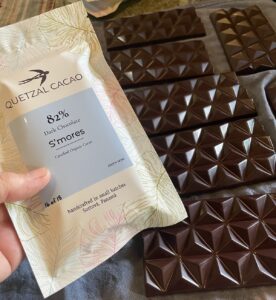
Quetzal Cacao 82% dark chocolate S’mores bar beside finished small-batch chocolate bars, handcrafted from certified organic cacao in Sortová, Panama.
Quetzal Cacao 82% S’mores, handcrafted in a batch of 18 in Sortová, Panama.


I still look at percentage because it tells me something useful. I also want to know what happened to the cacao before it became chocolate.

Here on the farm, that begins with the trees themselves. We harvest ripe pods, ferment and dry the beans, and eventually bring that cacao into the chocolate kitchen. What happens along the way affects the flavor we taste in the finished chocolate, and some of those same steps also affect the natural compounds in cacao.

Looking beyond the front of the wrapper

Living with the whole process has changed the way I look at food.

I know where the cacao in our chocolate grew. I know who harvested it. I can put my hands into a fermenting batch and feel the heat. Later, I can stand in the chocolate kitchen with the finished bar and taste what all of those decisions became.

Most of the food we eat does not give us that kind of access, of course. I do think we can become more curious about what happened before it reached us.

If dark chocolate is part of your routine, the percentage on the wrapper is a useful place to begin. Then go a little further.

Where was the cacao grown? Does the maker talk about fermentation or roasting? Can you learn anything about how they work with the beans?

None of that can tell you the exact flavanol content of a chocolate. Only testing can do that. It can tell you something about how closely the maker is paying attention to the cacao and to the stages that shape both flavor and the compounds naturally present in it.

Food choices have a long life too

Our health is shaped over a long time. Heart health is influenced by many things over many years, and food is one of the places where we make small choices again and again.

That does not require eating perfectly.

I am much more interested in choosing whole foods that are well grown, nourishing, and pleasurable enough to remain part of everyday life.

That is how dark chocolate fits into my own life.

I genuinely enjoy it. I would eat it even if nobody had ever published a study about flavanols. I am also glad to know that cacao contains compounds researchers continue to study for their role in vascular health.

Growing cacao as well as making chocolate has made the long timeline of food very visible to me.

A decision made in a nursery may still be with us decades later.

We improve soil knowing we may not see all of the results this season. We plant trees knowing they need years. We keep learning from people who have spent longer with cacao than we have.

The work is built through many small decisions made over time.

What are we choosing to carry forward?

That question becomes much larger when I look beyond our own farm.

I have been studying new research into Panama’s cacao genetics and some of the fine-flavor material growing here that is still barely understood.

As more cacao is planted around the country, I think there is an important question to ask:

Do we understand what is already growing in Panama well enough to know what deserves to be preserved?

I will be writing more about that as we continue learning what is already here and what the choices being made now may mean for Panama’s cacao in the future.

For the moment, there are about 300 fresh cacao seeds in our care.

If some of them become productive trees, the choices we are making with them now will still be present in our chocolate years from today.

If you have a favorite dark chocolate in your kitchen, go beyond the percentage on the front of the wrapper and see what you can learn about where its cacao was grown and how the chocolate was made.

And if this kind of conversation about cacao, food, land, and the life behind what we eat interests you, you are welcome to continue with me through the Hearth at lynbishop.com/hearth.

When a Word Becomes a Promise

Panama organic certification issued by ACERT alongside the MIDA regulations governing certified organic agricultural products.
Panama’s certified organic program is governed by national regulations through MIDA and verified by accredited certification bodies such as ACERT.

When a Word Becomes a Promise
What “Organic” Means in Panama

Most of us will never visit the farms that grow our food.

We will never walk the fields, meet the farmer, or see firsthand how a crop was grown. Instead, we rely on trust.

But what happens when we cannot verify the claims being made about our food?

That question led me to a deeper understanding of why the word organic is legally protected in Panama.

There was a time when I did not think organic certification mattered.

My philosophy was simple: know your farmer.

Over the years, people came to know our farm. They walked the trails, saw the cacao trees, tasted the chocolate, and asked questions about how we grow food. If someone wanted to understand our practices, they could come and see them for themselves.
In the early morning, when the air still holds the cool of the night and the cacao leaves catch the first light, the work feels quiet and steady. That is where this way of growing began.

So when the agricultural ministry reached out and invited me to certify some of our products as organic, I hesitated.

We knew we could meet the standards. We had been growing this way for years. I simply believed the work spoke for itself.

The soil, the trees, the way we showed up each day. I did not think a certificate could add much to a relationship built on trust.

Over time, I began to see something I had overlooked.

Most consumers will never have the opportunity to know their farmer. They make decisions from a market shelf, a roadside stand, or a grocery cart, often with very little information about how their food was grown.

When trust cannot be built through direct relationship, it must be built another way.

That is where certification enters the story.

What Organic Means in Panama

Many people assume organic simply means food grown without synthetic pesticides or fertilizers. While that is part of it, in Panama the word carries a specific legal meaning.

The term organic is regulated by the Ministry of Agricultural Development (MIDA). A producer cannot simply decide to call a product organic because they believe it was grown responsibly. To legally market a product as organic in Panama, it must meet established standards and be certified through an approved process.

One detail that surprised me is that certification is generally applied to products, not necessarily to an entire farm.

Today, twelve products grown and crafted on our farm are certified organic in Panama, including our saril, whose deep crimson calyces are harvested each season and transformed into one of our favorite farm products.

Organic is not simply an intention. It is a claim that must be supported.

When Trust Has No Anchor

A story shared with me recently brought this into focus.

A grandmother in Volcán was buying strawberries labeled organic for her sick grandchild. When she asked the seller if they were truly organic, she was assured that they were.

A short time later, she mentioned the conversation to me. I told her something simple: if the strawberries were certified organic, the producer should be able to show the certification.

She went back and asked to see it and was told the certification could not be shared.

There was no way to verify what she had been told.

She stood there holding the strawberries, unsure what to believe.

She was not willing to take that risk with a child who was already unwell, so she threw the strawberries away.

For a moment, there is nothing else to do but sit with that.

That is not a small decision. That is trust breaking in real time.

Without certification, there is no simple way to verify what is being claimed.

When trust becomes unclear, the consequences show up in kitchens, markets, and family decisions every day.

Extending Trust

This question reaches far beyond Panama.

People everywhere want to know where their food comes from, how it was grown, and whether the claims being made can be trusted.

It was never about replacing the relationship between farmer and consumer. It was about extending it.

Certification allows trust to travel farther than the farm gate. It gives someone standing in a market, who may never meet the grower, a way to verify what is being claimed.

It does not replace integrity or the work on the land, but it creates a shared language that can be recognized even without direct connection.

A Commitment Made Visible

In the end, this is not really about paperwork, even though there is plenty of it.

It is about caring for the land well, being honest with the people who buy our food, and using words with the respect they deserve.

Not all food is grown the same, and not all words are used with the same care.

It is reasonable to ask questions, whether you are speaking with the grower, the seller, or someone in between. It is reasonable to look a little closer, to ask how something was grown, whether it is certified, and even to ask to see the documentation behind the claim.

My philosophy has always been simple: know your farmer. Whenever possible, visit the farm, ask questions, and get to know the people growing your food. When that is not possible, certification offers another way to build trust.

For me, that is what the word organic has come to represent: not an idea, but a promise. A promise worth standing behind.
The kind you can trace back to the soil.

If conversations like this matter to you, I’d love to invite you a little closer.

The Hearth grew from that same idea. It is a place to stay connected to the farm through seasonal letters, harvest updates, workshops, chocolate releases, and the ongoing story unfolding here beneath the cacao trees.

We would be delighted to welcome you into the circle:
lynbishop.com/hearth


Lyn Bishop grows cacao at Finca Las Heliconias in Chiriquí Province, Panama, where she founded Quetzal Cacao, a tree-to-bar chocolate company. This article first appeared in Newsroom Panama and has been expanded here as part of the estate’s permanent archive.

Dream a New World

posted in: Uncategorized 0

Do you believe it’s possible to dream a new world into being?

In fact, my teachers and guides tell me that THIS the purpose of this difficult time right now.

They share with me that NOW is the time to reconnect with right relationship. To live healthy lives, in harmony with the environment, and with each other.

Today, it’s obvious that we’re living out of balance. The choices made by our ancestors about lifestyle, economics, health, medicine and so many more aspects of life have consequences. And the debts that were created as a result of those actions are now coming due.

Pachamama can no longer support us as she has for past generations. 

Not only do we inherit the choices of past society, but on a personal level, we inherit the beliefs of our ancestors. This includes the beauty of of our family lineage, but also the generational trauma, the hurts, wounds and even the unspoken belief systems in our family of origin.

Today’s message isn’t to beleaguer the obvious fact that we’re living through difficult times right now. Instead it’s a message of hope. I believe that we have the choice and the power to dream a new world into being. 

That’s not to say that it will be easy. In fact, in most cases, it won’t. When we take a good look at the life we live, and decide what right relationship means to us personally, chances are we may need to make some modifications to our lifestyle. 

Many wise traditions talk about the effects of the choices we make today having a lifespan of 7 generations. In my practice of seeking to live in right relationship here is the ONE QUESTION I come back to time and time again. 

Does the choice or action I am making today support the 7th generation in the future? 

It’s that simple. With each choice you make, ask yourself that question. 

It applies to every choice you make each day — to the food you eat, to the love you make, to the goods you buy, to the waste you leave behind. Do your choices today support the 7th generation in the future?

You have the ability to be the change, the question is, will you make the effort?

Infinite ∞ Love, Lyn

P.S. This message has been inspired by my shamanic teachers and also my meditations with Pachamama. If you haven’t had the chance to watch the film KISS THE GROUND, I recommend it. It helps to put the choices we’re making into perspective. xoxo.

STOP being a People Pleaser

posted in: Uncategorized 0

News Flash – there is a HUGE difference between accommodating someone to honor the relationship and being a persistent people pleaser. Do you know the difference?

Sometimes accommodating others is necessary to sustain a relationship that you value, even when you would rather not. This is part of the give and take of relationship, but, when pleasing others becomes a compulsive lifestyle, rather than a compromise, take warning from this red flag.

I know first hand, growing up in a dysfunctional family environment, I learned early on that pleasing others was a gateway drug to perceived love, acceptance and safety. It became easier to put others needs first, as it eliminated the conflict, the guilt, and the fear of not fitting in. I found that when I expressed myself, when I pushed back, tried to express boundaries and finally had the courage to say no, that’s when I was punished.

As I became an adult, the people pleaser in me persisted. I put in extra time at work, but still felt unseen. I became angry at my family for putting me in compromising situations when I was younger. I resented my husband because I felt unappreciated. Yet I continued to sacrifice myself instead of sacrificing the relationship. 

Does that sound familiar?

I felt trapped. Accommodating others became so ingrained in me that I lost touch with who I was and found myself in an abusive relationship not having the tools or the inner strength to face the overwhelming retaliation I faced every time I tried to exit. 

The underlying belief was that I wasn’t lovable, and I had to go through my own dark night to reacquaint myself with the parts of me that I had hidden. It was a process of relearning self-worth, and self esteem, and healing the shame I didn’t know I carried inside. But this journey of self-reclamation has been the most life affirming I’ve experienced. That’s why the work I do as part of Love Yourself Now is so important. 

Here are 8 questions to ask yourself regarding people pleasing:

  1. Do you apologize when you don’t have to?
  2. Do you resent others for not reciprocating?
  3. Do you always give more than you take?
  4. Do you forgive those who hurt you for fear of losing the relationship?
  5. Do you put more importance on other’s feelings than your own?
  6. Do you compare yourself to others?
  7. Do conflicts make you anxious whereby you avoid confrontation?
  8. Do you find it hard to set boundaries with some people?

Listen, there’s nothing wrong with being nice, but the first priority is to offer that kindness to yourself. 

I hope these questions challenge your thinking, and if they feel true to you, that they help you shift your behaviors into greater self-awareness. Having healthy self-esteem is a key element towards your mental wellness, and gives you confidence to move out of the people pleasing obstacles and into a future of understanding your innate worth. 

I’ll be honest, ditching the people pleasing has been scary. But, learning that not everyone has to like me has been one of the most liberating gifts yet. This sense of it’s okay to be me, unapologetically, has freed me in more ways than I could have imagined.

How about you? Do you ever find yourself playing the people pleaser, or are you soild in your self-esteem? 

Know that I’m here to listen if you ever want to share, and that I always love reading your comments.

1 2 3 4 17